It’s been well over a year since I’ve watched Miyazaki’s The Boy and the Heron, but, in a movie filled to the brim with fantastic imagery, one image has stuck with me more than others. That image is an old man, the master of the strange alternate universe that the protagonist finds himself in, delicately balancing an array of blocks. The blocks are not stacked in any logical way. The formation is totally precarious and seems like it must fall over. A cube balances atop a sphere, a cylinder stands upright with its base leaning over the edge of the block beneath it, and so on. It’s a wonderful image, and is central to one of the point’s of the movie, which is artistic vision and vocation, and ultimately, what an apprentice can and cannot take from a master.
Mastery
The movie is deeply concerned with the idea of mastery. Our hero, Mahito, finds himself in a strange world that really is a series of worlds that all share certain symbols–most obviously, the birds who populate these worlds in different forms. These worlds are all enthralling and strange, and have interesting resonances with the real world that Mahito has left behind, such as the young pirate woman who is clearly one of the older women that Mahito knew in the real world–her spirit is preserved here as a young sailor.
The point is, we finally get the the master of this world, Granduncle, who has this precarious stack of blocks. He is the master of these worlds, and as he explains, all these worlds are variations dictated by this stacking of blocks. This master is the creative, and the blocks are his “obsessions,” the things that he can’t let go of, that come back time and time again in his work (think of Scorsese and you’ll think of gangsters, power dynamics, Italian Americans, etc., or of Tolstoy and you’ll think of human nature, the soul, the upper class v. the peasant class, and so on). He says they are the things that he has found in the world that are free of malice–ideas that are true, beautiful, pure. The movie seems to be saying that an artist tends to actually only have this small set of obsessions, and that, in turning these things over and over, giving them different shape, proportion, balance, and so on, an artist is able to continually create. Certainly, it is interesting to take a look at artists one loves and look for these constant obsessions. The master then isn’t necessarily one who is able to come up with completely new obsessions for each work–indeed, this would seem impossible–but is instead someone who is forever giving new form to the same set of ideas, or the same “vision”.
Apprenticeship
The master then sees Mahito and recognizes in him the artistic vocation. His initial instinct is to force his own vision, his own set of blocks, onto Mahito. But at the end of the film, the master and Mahito both recognize that this is impossible. While the master and the master’s works have given Mahito an apprenticeship in the artistic life, the artist is not one who simply reiterates what someone else said and did. The artist must strive to cultivate his own vision. From his greatest master, from whom he learned the most, Mahito only takes a single block, a single shared obsession, or obsession is the wrong word. A single, pure idea, free from malice, from which he must then go out into the world and add more blocks, all in order to complete his own vision to which he will give artistic expression. The master raises the apprentice up, only to let him go, ultimately giving him the gift of freedom to create a world entirely his own.
One of the most persistent battles I’ve fought as a fiction writer is against the English Major mind. What I mean is that, frequently when I write, my mind gravitates toward thinking about what the story I’m writing “means”. The meaning of a text, or of any work of art, is what we’re taught to focus on in the setting of a literature class, or in any discussion of art as a whole. We, culturally, have taken art as essentially a form of rhetoric, conceptualizing fiction as basically an essay written in code, and the student of literature, like Alan Turing, must break that enigma. Once the code is cracked, the literature reveals itself, and once its message is understood, the reader can happily move on.
This framing of fiction as rhetorical extends out to all works of art. In our own day, we make very piece of art about politics, since politics is basically all anyone talks or thinks about. So we analyze everything through the rhetorical lens of what its message is politically.
However, you’ll find that often in interviews, artists are asked what their artwork “means,” and the question, bafflingly it seems to us, leaves them at a loss for words, perplexed. They may even deny ever thinking of such things. But worse yet, as I’ve written about elsewhere, some artists are over-eager to explain their works, to the point where the explanation, the rhetorical message of the work, seems more important to them than the art itself.
The Intuitive “Yes”
Annie Dillard, in her wonderful book The Writing Life, returns again and again to images of artists who have no idea what the outcome of their art will be, what people will make of it. They describe feeling like they are simply pulling on a string to see what comes at the end of it, or, in the famous example she provides of the stunt pilot, that he is, essentially, hanging on for dear life, keeping the sun on a certain side of his face, and so on. She portrays art as process-driven, as giving in to a certain experience, regardless of the outcome.
But what exactly is this experience? George Saunders seems to give the answer in his book on craft, A Swim in the Pond in the Rain. It’s worth quoting in full, which I will pull from a piece he wrote in The Guardian that goes through the exact analogy:
A guy (Stan) constructs a model railroad town in his basement. Stan acquires a small hobo, places him under a plastic railroad bridge, near that fake campfire, then notices he’s arranged his hobo into a certain posture – the hobo seems to be gazing back at the town. Why is he looking over there? At that little blue Victorian house? Stan notes a plastic woman in the window, then turns her a little, so she’s gazing out. Over at the railroad bridge, actually. Huh. Suddenly, Stan has made a love story. Oh, why can’t they be together? If only “Little Jack” would just go home. To his wife. To Linda.
What did Stan (the artist) just do? Well, first, surveying his little domain, he noticed which way his hobo was looking. Then he chose to change that little universe, by turning the plastic woman. Now, Stan didn’t exactly decide to turn her. It might be more accurate to say that it occurred to him to do so; in a split-second, with no accompanying language, except maybe a very quiet internal “Yes.”
He just liked it better that way, for reasons he couldn’t articulate, and before he’d had the time or inclination to articulate them.
“He just liked it better that way.” Imagine giving that answer to your high school AP English teacher when they asked you why Melville spent an entire chapter talking about the whiteness of the whale instead of cutting it altogether. And yet, this seems the truest explanation of why.
Learning to See
Now, I have been listening a lot to the band Geese and Cameron Winter’s solo material. I came to them through them opening for Vampire Weekend in Philly. Something I think a lot about is their song “Long Island City Here I Come” from their recent album, Getting Killed. That whole song to me feels particularly inspired, as though they just continually said yes to stranger and stranger escalations in the music that, nevertheless, felt just right to them. One of the most hilarious and inspiring moments is when Cameron Winter sings “I’m about to kick your ass up and down this street” then proceeds to mutter “Here I come” over and over again and let out strange vocalizations for several minutes straight. It’s strange, funny, a little deranged, totally awesome, and, it would seem, deeply inspired, and inspired by a “Yes” that the entire group of musicians, or at least, some of them, must have felt when that moment first emerged.
The above-mentioned Vampire Weekend has tons of moments like this in their music too. I mean, from the jump, who would have thought of combining pop music, African rhythms, and Western classical influences into a single thing? I actually don’t believe it could be totally thought up. It had to be felt. In their song “Mary Boone,” off their most recent album, a sitar, an elegant piano riff, a hip-hop-style backbeat, some strings, and a choir, all play together at once after each chorus. It really shouldn’t work. But it totally does.
In their song “Ya Hey” (which features some chipmunk vocals that, again, really shouldn’t work, but do), they pretty explicitly reference this kind of bizarre genre-mashing in the bridge:
Outside the tents, on the festival grounds As the air began to cool, and the sun went down My soul swooned, as I faintly heard the sound Of you spinning “Israelites” Into “19th Nervous Breakdown”
Here, this very mixing of incongruous sounds is attributed to God, here represented as a DJ at a festival. They’ve touched something deep, something like reality or Being itself or God, in this mixing.
Now, I’ve spoken only to really over-the-top, explicitly “inspired”-feeling moments in song, but the point is, all of the song, every moment, must feel touched in this way, the musician must feel that “yes” at each moment of the song. Often, especially at first, it may be only the musician themself who feels the “yes”. I think here of Jack White, who, now famously, showed the “Seven Nation Army” riff to a friend, who was unimpressed. It is, in the grand pantheon of riffs, taken on its own, really not the greatest thing. And yet, White simply felt differently. He heard the riff and felt the internal yes, and pursued it to a song that is now an iconic anthem.
Similarly, you might be a musician. One of the things that may young artists do is write music that sounds like the musicians they like, but ultimately, they don’t find that satisfying. Why? Well, they chased someone else’s intuitions, vision, inspiration, “yes”, not their own. I love Jack White, but when I write songs, I stay away from riffs. They simply don’t excite me when I write them. Now, each song, story, painting, whatever, has its own craft and must be followed through on by the artist according to their own intuition, meaning one day, a riff may strike me as a “yes”. It simply hasn’t happened yet, but one should remain open to possibility. This is also why people a bit more tuned in to art are repulsed by music that sounds too much like music that came before, or like a pop-form of that music that is packaged to sell to the radio and Spotify and all that. It is clearly not the vision of the artist, but a stolen vision, and a decidedly lesser version of that original vision.
Back to Stories and Rhetoric
All this is not to say that stories, songs, and any artwork, doesn’t have meaning. I think they actually tend to have many complimentary meanings, particularly if they’ve struck beauty, being, reality, since reality can be looked at from a number of different angles to find a number of true, complimentary takeaways. Some saints were kings, some went to live in the desert. This is all only to say that these meanings are best discovered and fully worked out on the other end, often without the artist. Nothing ruins a work of art as readily and with as much good intent as pushing the meaning/message of the story so far forward that it ruins the inner workings of the art itself. I think of Chesterton’s White Horse, which is a really fun epic poem that then has to end with Alfred having a vision that the pagans will return, but with pens instead of swords! It flattens the entire poem to basically a message directed at barbaric academics, which, even if an important message, flattens the story. Or, similarly, moments like the girlboss moment in Avengers: Endgame, where for reasons inexplicable, all the female superheroes and none of the male ones have to carry the infinity gauntlet for a few moments, forcing a message into a scene at the expense of the scene itself.
As an artist, it is completely damaging to your art to be too focused on a rhetorical dimension of your work, because it will kill the “yes”. I found this moment from a Cameron Winter interview in Far Out:
“I feel like there’s nothing worse than going into a song, like ‘I have something to say with this song’.”
He continued, “Because then it’s just too much, like you’d end up writing a song that’s all about some super-specific issue – they don’t age very well, those songs. The clearer the message, sometimes, the less powerful it can come across.”
He added jokingly, “It doesn’t come across artistically. You should just make a tweet, or something.”
However, the singer-songwriter admitted, “Sometimes I do have something to say, unfortunately,” before admitting, “I get self-conscious about being too on the nose, and then if I’m not on the nose at all and it’s just like Goobledee-Girk, Lewis Caroll, horse-talk. Then I have to reverse engineer the message.”
He is exactly right. If you have something to communicate, write a tweet, or an essay. Essays are wonderful! But a song shouldn’t be an essay, a story shouldn’t be an essay.
The truth is, it seems to me, that while art can communicate truths, it does this by essentially capturing something deeper than can be expressed in, say, a string of formal logic, a speech, a debate, whatever. Those things are all well and good–all well and great, actually–but art taps into a deeper vein, where an entire fabric of truths and intuitions became a rich tapestry married to an expression given material form (a painting, a song, a narrative) that is beautiful. We can then go back and pull on some of those strings to explain those truths, but the artist is the person who is simply working their art (trying to make a painting look just right, trying to have a certain scene really capture the horror of loss, trying to give someone a character arc that makes sense, etc.). If they’ve written something “true,” something that gives them an intuitive “yes,” then, having touched the Real, it will be able to be dissected and discussed in hindsight, as it were.
Tuning into the “Yes”
The goal of the artist, then, is to tune into the “Yes”. I believe there are periods of learning where other things should be focused on. Certainly, a beginner fiction writer should learn the art of plots, character arcs, sentence structures, word choice, and so on. They should read the classics, the great works, and try to take them apart and see what makes them tick. They should workshop and learn from teachers (I’ve actually found one of the great benefits of workshopping is that readers pick up on moments where I wasn’t feeling the “Yes”–they could sense it, and could tell something about that part just didn’t work, which helped me tune into the intuitive sense more). I think people should read philosophy and try to come to a deeper understanding of art in general. But when really trying to work, trying to write, let go, lock the English Major out of the room. Lock the Alan Turing out of the room. Artmaking isn’t a code to crack, but a dance to dance. So go for the “Yes”, and revise and revise until the entire story feels like one long, protracted “YES!”
Someone looks at their phone for an hour. They are interested the entire time. They scroll through their Instagram, then their email, then their YouTube shorts, then their Instagram again (after all, they posted earlier and are checking to see who liked their post), then their TikTok, then their Instagram yet again. It’s easy and fun. It feels like relaxing, a full body and mind relaxation. They are encountering new, titillating things nearly every moment. Their eyes and mind linger on nothing for long. A short about diet. A short about building a fence. A short about a group of girls in bikinis at Spring Break. There interest feels insatiable, and they don’t realize how strange their activity would look to an observer, flickering quickly back and forth between wildly different images. When the hour ends, they look up from their phone and the world looks a little fuzzier, a little sadder, a little more grey.
Someone reads Anna Karenina for an hour. They are occasionally bored, or confused. Russian names are long, and they are pretty sure each character has three or four names, but they aren’t certain. But there is a good plot, and they like the characters. It’s a bit of a trial. And yet, there are those moments, ones where something is illuminated in a completely new way, like when Levin skates beautifully, not knowing that Kitty doesn’t love him. They understand something new in that moment, something inarticulable, at least until later reflection. There are even stretches where the minutes slip away–what first felt difficult, perhaps impossible–is suddenly easy and completely immersive. They see the characters, feel the things they feel. If it’s a man, they find that they’ve never seen a woman quite as deeply and truly, perhaps, as they see Anna; if a woman, they feel they understand something about the souls of good men and bad men through Levin and Oblonsky. When the hour ends, they look up from the book, and things are a little brighter, a little sharper, a little more clear.
What has the great work of art done? Imagining a third scenario might help.
Imagine a third scenario. Someone looks at the night sky over Lake Erie for an hour. They aren’t necessarily titillated, but there is a quiet engagement and wonder. They don’t know much about constellations, but they can make out the Big Dipper, and from time to time they see something pass overhead. Maybe it’s a shooting star. Maybe it’s a satellite, or an airplane, or a drone. The waves quietly lap on the shore. Their mind drifts in and out. They think of a mistake they made earlier, and they regret it, and then think about the future, or some pleasurable moment from the day, or a plan in the near or far future. Perhaps even the gestalt of their whole life may hit them. When the hour ends, they go inside and go to sleep, and the day is done.
So again, what has the art done? With John Senior, I would like to posit that the great art of Anna Karenina has done something like given you a vision of life in its totality. Your own life, your own personal experiences, your encounters with nature, can of course give you that to some degree, particularly if you reflect on these things constantly. But great art, great fiction, allows you to see the world through the eyes of a great artist who has considered their story and the people in it with intense, loving contemplation. You then, for the time you read the book, are given access to that very same contemplative, loving mind. From the pages of the book, you can then actually see your own life and experiences a little more clearly, learning to see things properly with the eyes of the heart.
Seeing in Two Dimensions
I’ll dive more fully into this when discussing character writing, but an important thing to note about phone use is this. One of the great promises of social media is its connectivity. The promise–people my age remember the promise, because it was given to us when we were children and the technology was new–was that you would connect even more with people. The utopian vision given us was that our communities would be even better, our friendships even stronger. We’d all grow closer to each other by interacting constantly online.
The issue (or one of the issues) was this–the way social media is designed, with every post and picture meant to be easily and quickly consumed, people on social media by necessity turn themselves into a sort of easily understood and digestible product. People frame themselves as the tough, masculine man who does things like hunting, or as the cool, adventurous girl who surfs and skateboards, or as the carnivore who only eats meat, attributing this to a full improvement of their entire life, or as the vegetarian who does the same, or as the tradwife, or a golf instructor, or a handyman who takes on outrageous projects, or whatever (you see many of the most popular influencers lean toward making themselves not simply 2-dimensional people, but 2-dimensional cartoons). People make themselves into 2-dimensional figures, easily understood and consumed for a quick turnaround for “likes”. This is what D.C. Schindler means when he talks about the nature of social media and “liking”. The likes are necessarily only surface-level attachments. We like very simply, easily understood things. We are in no way even given the opportunity to love these people because we actually do not know them, because people are in fact complicated and 3-dimensional, not 2-dimensional.
And if you use social media, you do it to yourself, essentially trying to market yourself for likes. If you do something other than this, attempting to show different sides of yourself, good and bad, interesting and not so interesting, you are either not very well-received because you haven’t created a true Brand of You, or even that is seen as a kind of ploy for attention, which it quite likely is.
So, when we look up from our phones, having ingested a 2-dimensional world that is something akin to a Halloween bag stuffed with different candies, always something new and delicious, never something nourishing, and we look up to the real world, our imperfect apartment, perhaps our spouse who we do have to see in 3-dimensions, our own lives which we certainly have to see in 3-dimensions (though we can try our darnedest to not through drugs or manipulating our circumstances with plastic surgery or whatever), well, it’s clear to see why actual real life would seem a little dull and dim. Who wants to eat a steak after they’ve stuffed their faces with Halloween candy?
Art & Contemplation
So why is art different? Why does it make life feel more rich, not less? It is because art teaches us to see. Like the Professor says in Fahrenheit 451, true art shows the “pores” in the face of life. It shows us reality in some way, by showing people in 3-dimensions (great art can also show an idealized figure, like the Hero, and can be great art in that way with a 2-dimesnsional figure who shows us what we could be–again, something we’ll get to when we fully discuss characters). Through its many layers (character, theme, symbol, plot, arcs, etc.) it can give a true, organizing picture of life itself. This is also what Flannery O’Connor means when she says that writing fiction (and I think, by extension, reading fiction) is a “plunge into reality” and is “very shocking to the system.” Fiction (and great art in general) has a way of plunging us deeper into the reality of life than we are actually accustomed to doing, which then makes our own lives much more interesting and loveable.
Ok! So how exactly does this happen?
The best art stems from richly observing life, reality, people, God, and stems out to its audience to give them those same qualities. A person who lives their life in reality, away from their phones, has a lot of raw material. They’ve encountered reality. The work of the artist is then to shape this raw material into a true whole. Great art, in a sense, shows us how life itself, reality itself, works and is. Beauty, and beautiful art, is “truth and goodness on the meeting ground of the sensible,” (D.C. Schindler).
One of, if not the deepest reality that the artist can perceive is the reality of love, of life wanting to give of itself, communicate itself, to all around it. As Peter Kreeft says, “Things are in love with other things…fire gives warmth, light gives clarity.” Things give of themselves to other things. There is a fundamental generosity and relational quality to being, and as the Catholic believes, this is one of the great truths God has revealed about Himself to us, that He is a relationship of love, the three Persons in constant communication of love with one another and with the world they created out of this same love.
So for a writer, the most important things we can do is to love our work into existence, and in particular, to love our characters into existence.
George Saunders is a contemporary author who has seen this very thing. He talks about a writer who writes the sentence “Bob was an asshole.” While at first, the sentence pleases the author with how direct, smug, and kind of humorous it is, the artist is ultimately displeased with the sentence. What did it mean that Bob was an asshole? How? Why? Eventually, the author, through revision (meaning, re-contemplation of the story and individual sentence) comes to something like “Bob snapped at the barista, who reminded him so much of his dead wife, whom he missed dearly.” The sentence and Bob and the worldview of the story have come into much sharper focus through this process of revising, of contemplating the story and its characters more and more deeply. Saunders and I agree that the only way to great art is this sort of contemplation in love, a viewing of the story with the eyes of the heart.
In fact, a way of thinking about creating art is that it’s a kind of contemplative map or board that you slowly, lovingly fill in and deepen.
You’ll find, for example, when writing in essay, that you discover more by the final draft than you had initially thought to put in. Ideas layer on, examples add up, new ideas emerge.
A similar thing happens when writing fiction. Tolstoy first conceived of the character of Anna as a wretched, ugly, fat, miserable woman through whom he could teach a moral lesson. But, along the way, he fell in love with her, and she became much more than that as a result.
The Renaissance
One of the reasons the Renaissance is perhaps the greatest period for visual art ever is because it captured more of reality than any other period. While the Middle Ages captured many deep, spiritual realities through its more highly-symbolic art, the Renaissance was able to marry those spiritual realities to material, bodily realities.
What is true of the Renaissance is true of the Victorian period in English literature, or more generally, the 18th/19th centuries in World Literature. Through their fictions, these great authors (Austen, Dickens, Eliot, Tolsoy, Dostoevsky, Checkhov, etc.) were able to capture very human life while marrying it to higher, spiritual truths and realities. They captured more of reality more truly than other eras (with brief, bright lights throughout the ages–the greats like Homer, Dante, Chaucer, etc.).
A False Worldview Harms the Art
Now, I didn’t always hold the view that should an artist’s worldview be wrong, their art would be seriously harmed. Beauty, I thought then, was completely disconnected from Truth, and so something could be beautiful and at the same time false. I think now that a falseness in worldview does serious damage to art.
If art is meant to reflect and organize reality, be a “deep plunge” into reality that sort of “shocks” us, wakes us up to our own lives and the things at stake, then a false worldview means a plunge into a false world, one that does not accurately reflect our own, and can thus either leave us wondering the point of reading something so wildly false or actively mislead our understanding about our life. I think about a few works in particular. One is Blood Meridian, one of Cormac McCarthy’s finest works. Many virtues of great writing are there. The story is intense, some of the characters are incredible, the language is unbelievably strange yet precise. There are scenes which are completely unforgettable, and a real power to the story. And yet, the worldview of the story is that evil is everywhere, goodness nowhere, and ultimately, we must submit to the nihilistic violence of man. Now, the depth of this lie, the weight of it, the intensity of it, is part of what gives the book its magnificent power. And yet, and yet. Ultimately, one must look up from the book and realize that love exists, that justice exists, that people sometimes do good for goodness’ sake. And one must conclude that they’ve just seen a wild, intense, but utterly false picture of the world, one that has given them, as a result, insight into very little. Worse, one may come to believe it, and perhaps come to respect, say, a school shooter, or a suicide bomber. This is why The Road, which I think gestures toward hope through the character of the son and the people who ultimately come to care for him after the father’s death, is, I think, a more complete, probably better work. It has a more complete worldview.
Something similar is seen in the difference between the film versions of The Lord of the Rings and Villeneuve’s Dune. In Dune, everything is about power. The Harkonnens want power, the Atreides want power, the Emperor wants power, the Fremen want power. Power is the controlling spirit of that world and that story. This is why, when Paul wins at the end of the movie, we basically feel nothing. Power, albeit good-looking power, has won out over another Power, a worse-looking power. The difference between the Atreides and the Harkonnens is basically aesthetic. If the Harkonnens had won, I don’t think we’d feel the depth of tragedy, because again, no deep tragedy would have occurred.
Now, in The Lord of the Rings, we get a much more complete picture of the world. Basically, in that story, there is good, and there is evil. Goodness manifests in characters who are virtuous, heroic, selfless, open to friendship and love, concerned for the past and the future, caring for the world. It manifests in architecture that is more humble, and even when grandiose, such as Minis Tirith or Helm’s Deep, seems to fit in naturally with the landscape, with the natural world, using material found naturally in the world around it, rocks and stones and granite. It manifests in people putting aside their lower concerns for some greater cause and good and in creative problem solving to complex situations. Evil, meanwhile, manifests in characters who are selfish, conniving, quick to betray, hungry for power. It manifests in architecture made out of metal, architecture that actually destroys the world around it in order to be made, with images of lava, fire, machinery, and so on. It manifests in a critical stupidity, a lack of sight even from an all-seeing eye which is blinded to humility, to the idea that someone would humbly do something good for another person. When the good guys triumph in this film, we are jubilant, elated. We see how true a victory this is. If Sauron had won, we would have sensed and felt the great horror and tragedy of this, all because it has been made clear what goodness really is and what evil really is.
So while both are excellent blockbuster movies, it seems that Lord of the Rings will be loved and cherished for much longer than Dune, and I think this genuinely stems from the former movie having a truer, fuller picture of the world. It is a better work of art because it is more true. As a result, when you watch Dune, you are entertained and probably even impressed, where when you watch The Lord of the Rings, you are entertained, impressed, and edified. The art has stepped up to match reality and your soul’s lofty desires.
Even imagine a much smaller example, say, the proclivity of people in horror movies to make incredibly dumb decisions. Everyone at a certain point notices this, and it harms the art, it harms the believability because it has become detached from reality. Moments like these in art make the audience take a step back from the work and test it against what they know about people and the world, and the art comes up wanting. Enough of these moments pile on, and the viewer is likely to simply close the book, turn off the tv, and do something else instead.
AI
I want to touch briefly on AI use in art. Basically, I hope that it’s clear from all the preceding that I think AI is the death of art. One way of considering this is by considering the artist themself, the person behind the art.
One could argue that AI merely does what humans do; it takes all the art it has ingested and turns out something new that is a kind of hybrid composite of all of those other things. AI has access to all the novels, short stories, and so on that we have (though hopefully in reality it actually doesn’t for the sake of artists owning their work), and it simply does exactly what we do.
However, this only describes part of what an artist does. Of course, a writer has hopefully read a lot of fiction, especially pursuing reading the “greats” as well as reading widely in things that they enjoy. Now, something is already critically different here. An artist actually encounters these things, wrestles with them in their mind, comes to love them or despise them in their heart. These are obviously things the AI cannot do. An AI has no relational capabilities because the AI itself is not a person. It has no soul. It doesn’t have the capacities for the highest orders of reasoning (exiting the Cave and coming to know reality through firsthand experience and thought), nor does it have access to the deeper reality of love and relationship. Similarly, an artist has actually lived a life and encountered reality and developed an actual point of view, all things the AI also cannot do, and even in theory, will never be able to do. So while there is a chance that AI-created false art will become bestsellers (though I really doubt that as well–AI slop is just that: slop–and even human slop like Wiseau’s The Room is far more compelling than AI slop), there is as much a chance for AI to write the next War and Peace as there is for a cockroach to do so.
Living in Reality
So a task of the beginner writer is to learn to see things properly. As John Gardner wrote that writers should watch as little tv as possible, watching only the really excellent stuff, so as to not start putting two-dimensional tv actions in their fiction, so would the fiction writer today do even better to stay off the Internet, AI, and particularly social media, as much as possible, lest they learn to see all people as 2-dimensional absurdities. These things will give you the wrong ideas about life and people, which will greatly diminish your art. Pay attention to reality, to your life, and for heaven’s sakes, read some philosophy and history. These things will all be touched on again later when I write on the writer’s vocation.
Literature has a tough question to answer in education, namely, why is it even there? Beyond that, why does it seem to be taken a bit more seriously than, say, an art or music class, but less seriously than the obvious pillars of modern education, math and science?
This is an ancient dilemma. In a rather infamous scene in The Republic concerning how a person is to be educated, Socrates advocates for removing poetry from his Republic. While praising Homer as clearly the greatest of all the poets, the one with the greatest command of story and language, he also criticizes Homer for his portrayal of the gods as deeply flawed, petulant, argumentative beings. Socrates’ reasons is that the gods must in fact be perfect, so to portray them in such a way is a lie. As such, Homer, in an ideal society, would be banned, lest people be led astray from true belief and right worship.
I’ve also heard that, in some medical schools, Samuel Shem’s The House of God, an irate satirical diatribe against the medical establishment, is recommended and fought against in equal measure. Those who recommend it tell people that it will open their eyes to all the horrible things about medicine, while those who oppose students reading it say that it will make these young doctors-in-training jaded about the very idea that medicine can be helpful. Notice that both sides of the argument agree on one thing–that the work will deeply affect the reader and change the way they see medicine.
And of course, every public school and liberal arts college celebrates Banned Books Week, but de Beauvoir forbid someone says they read Ayn Rand, or, far worse, says their favorite books are the Gospels, or the Letters of Paul!
It seems, like so much in our world, we hold two contradictory ideas in our minds at once with very little attention to the cognitive dissonance this should cause. On the one hand, we despise book banners and book burners of all stripes–one of the most common images of the Nazis is a large pile of books being burned. On the other hand, if a someone were to see 50 Shades of Grey at an elementary school, surely the reaction would be that this was unacceptable. The debate over whether certain LGBTQIA+ books should be included in libraries wages on throughout the country. Meanwhile, surely there are many who would and have had the same reaction to, say, a prominent display in a public school library of the Bible. Personally, when I saw a copy of a novel by musician and Hawaiian shirt enthusiast Jimmy Buffet at a used book store, my first thought was that this of all books should be burned. All this to say, we cry foul over book bans and book burnings, then move in all directions to ban books. We fear books because of the power we know them to have, and we push books because of that same power.
The Transcendentals, the Human Person, and the Power of Art
To move forward here, a quick digression is needed. Basically, we need a brief understanding of the human person and the person’s relationship to Reality or Being. To try and put simply, we can think of a person as having a mind that is made to know the Truth, a will that is made to do the Good, and a heart that is made to love the Beautiful.
So, there is truth to reality. That truth is what we come to apprehend with our mind, from 2 + 2 = 4 to the notion that Love is something like “willing the good of the other” (Aquinas). These truths shape our mind, the way we see things, the way we understand, and of course, has some effect on our will and heart (if we know it’s better for us to eat beef than ice cream, we may choose to eat meat more often, or if we know that Mozart is considered one of the world’s greatest composers, we may will ourselves to listen to him more until we love him). Ed Feser, the famous Catholic philosopher, has said that through coming to know and understand Aquinas’ famous Five Proofs, he came as an atheist to assent more and more to the Catholic faith and to love it.
There is also goodness to reality. We want to grow a good apple tree, one that bears fruit, and not a bad one that bears no fruit. Or, we see manifestly good actions, virtuous actions, and will to imitate those actions (reading how Christ lived, or even seeing how successful someone was and how they lived to get there). We “do the Good.”
And finally, we love the beautiful. This is quite obvious when you’re a teacher. Of course, a student can be an A student or an F student, knowing or not knowing just about every truth the school has to teach them, but if you make fun of math to either of them, they won’t be much moved. Now, let’s say both the A and the F student are fans of K-Pop. Should you make fun of K-Pop, you will forever lose that student, who will come to despise you, or become incredibly argumentative, or cry. K-Pop has moved their heart. In short, they love it. (Again, there are of course connections–it is highly likely that the point of an education is for the student to actually love things like history as well, it is just harder to get there).
So the power of art is namely this–it most directly and powerfully affects the heart. And the heart is the engine of the entire human person. “My weight is my love,” says St. Augustine. “Wherever I am carried my love is carrying me.”
So if you know someone who doesn’t read history or philosophy or just actively live their life and instead consider the evening news their main source of truth, you may consider that person has a weak mind, or does not know all the things that they ought to know for proper human flourishing. Indeed, that person might become a little strange, talking only of this or that bill or election, being argumentative and testy, and perhaps even the friendship ending should they find out if you voted for someone other than their candidate. In the same way, someone who hasn’t read Dante or Homer, or listened to Mozart, Bach, Beethoven, who doesn’t ever go outside to look at the sun set over the hills, a person for whom the current Top 40 (or worse, AI music) is their main source of beauty, you may consider that person has a weak heart, is not properly attuned to the beautiful, actually loves the wrong things.
Propaganda
Now, this power of art over our love (and therefore, over our entire life) comes loaded also with the fact that art presents worldviews and truth claims. We will focus mainly on truth claims here, as worldview is something that will be more deeply discussed in the next chapter, “Learning to See”.
To put it simply, especially in art that contains language, truth claims are often made. And, these truth claims, when married to art, have a powerful influence over the human person.
Three instances of truth claims within music come to me. The first is the many parties in the 2010s I attended where the song “Young, Wild, and Free” by Wiz Khalifa came over the speakers. People would sing along to the super catchy hook, swaying to the beat, somewhat mesmerized by the druggy, hypnotic spell of the song. The lyrics, of course, go
So what we get drunk? So what we smoke weed? We’re just having fun We don’t care who sees So what we go out? That’s how it’s supposed to be Living young and wild and free
The entire song is a kind of rebuttal to someone who might say you should not do the things that the narrators of the song do. Now, I don’t want to say that everyone who loves and heard that song did all those things that the song encouraged because the song encouraged it. That wouldn’t be true. But the song contains, essentially, truth claims, that doing drugs and partying is simply a natural and even positive part of being young. And certainly this song and the hundreds or even thousands of songs just like it have certainly had a power to convince young people that this is a completely normal–in fact, perhaps the only normal–way for a young person to act.
A second and similar instance happened at a party at a friends house, when the song “F— Donald Trump” came on the stereo. I had never heard the song–I wasn’t a very political college student, and in fact, politics really just annoyed me and seemed more pointless than anything. So imagine my surprise when, it seemed, every single person at the party chanted the hook, “F— Donald Trump,” with a kind of trancelike catharsis. I wonder how many of them could actually name a single policy of Trump’s. The point isn’t that they should either have supported or not supported Trump, but rather, that the song was a piece of political propaganda which created truth claims within art that powerfully effected the people at that party. Not to be cliche, but it was a moment that can only be compared to the “Two Minutes Hate” scene in 1984 where the crowd works themselves into a frenzy while the image of the political enemy, Goldstein, is played on a movie screen.
Tied to this second example is my final example, where, at many concerts, the music was put on pause about halfway through a show so that the musician could deliver a blistering, albeit vague, political screed to the roaring applause of the thousands in the crowd.
The broader topic of propaganda is probably too large to be covered within this series, but suffice to say, if truth claims within art can affect the individual, they can certainly affect the masses, and one should be very careful with any artform that is communicating truth claims, whether music, or movies, or even the evening news, which powerfully uses image and narrative to create entire worldviews for the audience.
Even on an individual level, whose mind hasn’t been changed by a powerful work of art? Say, a child reading To Kill a Mockingbird for the first time and recognizing the evils of racism? This isn’t a negative example–it’s actually largely quite positive. But the problem is, truth claims don’t have to be true–they can in fact be vicious lies. And a vicious lie combined with a work of art creates a brew between the head and the heart so potent that it’s not easily, if ever, undone.
The Truth of Fiction
Now fiction, as an artform built on words, has incredible powers to make truth claims. In the spectrum of fiction to philosophy, there are many works, like George Orwell’s, or C.S. Lewis’, that are something of a perfect blend between the two–great works of art that also contain many powerful philosophical points that the author seems intent on communicating to the audience and even convincing them of. Even pretty bad art can be quite convincing. No one is claiming Uncle Tom’s Cabin as anything like a literary masterpiece, but we all learned in school how important a tool it was to convince the nation that slavery was a grave evil.
The Aeneid is another example of art that is, in a sense, propaganda. It is, in effect, trying to create a unifying narrative of Rome and the Roman people as descendants of Troy and eternal enemies of Carthage. And yet it is, perhaps more importantly, a tremendously beautiful work of art.
In fiction, it is often the case with these types of philosophical works that characters symbolize or represent certain ideas. So in Black Panther, Black Panther represents Dr. Martin Luther King’s ideas of a world where race doesn’t matter and that people are all treated as brothers and sisters, while Killmonger represents Malcolm X’s more violent brand of Black superiority. In the end, Black Panther recognizes the righteousness of Killmonger’s anger while rejecting his notions that the Wakandans (themselves representative of Black people everywhere, though perhaps especially in America as an American movie) should dominate all other life on Earth. The movie–wildly entertaining, surprisingly emotional–is also making grand philosophical points through using its characters as stand-ins for ideas. Or in Beauty and the Beast, Belle represents all young women, beautiful and lovely, though perhaps a tad naive to the world and to how love actually works. Beast represents all young men, unaware of how rudely and brashly they behave and the negative effects that has on those around them. The two then fall in love and complete each other–Belle becoming a bit more realistic and centered, Beast becoming a bit more civilized and gentle. It is “a tale as old as time,” representing all true love stories.
Other times, worldbuilding is used to communicate ideas, most obviously in Utopias and Dystopias like Herland (in which a trio of men discover a utopian land of only women), 1984 (about a perfectly complete reign of an authoritarian government), and Brave New World (about a world where science and eugenics and hedonism has come to completely dictate the masses of humanity). Dante’s comedy, about the afterlife and the kind of people in it, works in a similar way. In these stories the worldbuilding does the heavy lifting on the philosophical front, and the story and characters are there to basically move through that world for the reader to see how it functions and how it affects the people within it.
Other times, the truth claims lie in the dialogue or interiority of the character, like in The Brothers Karamazov or Anna Karenina. Or it is in the narrator’s own commentary on the story, like in Middlemarch or Slaughterhouse-Five or War and Peace, which ends, preposterously, with a fifty or so page essay on the nature of history and free will. Or in Terrence Malick’s A Hidden Life, people make all sorts of verbal arguments as to why the main character, the now-sainted Franz Jägerstätter, should simply fight for the Nazis, while Franz, unable to put together any sort of logical argument, proves them wrong simply in how he lives a good life.
Or it can happen on a symbolic level. I think of a Bluey episode that is completely wordless. It is raining, and Bluey, a little girl, wants to play a completely arbitrary and childlike game out in the rain. Chili, her mom, wants to stay inside. Playing in the rain symbolically represents childlike joy, while staying inside symbolically represents adult concerns. The two are in constant conflict throughout the episode. At the end, Chili finally goes out into the rain–but with an umbrella. She is still symbolically holding on to adult cares. But, at the very end, to fully participate in Bluey’s game, she actually loses the umbrella, using it for Bluey’s game rather than to protect herself from the rain. So on a symbolic level, childlike joy and wonder is shown to be ultimately superior to adult cares and concerns. Similarly, in the novella A Christmas Carol, each Ghost looks a certain way, with each detail of their appearance having symbolic bearing on the Past, the Present, or the Future. So the Ghost of Christmas Past is a candle that flickers and constantly changes shape and appearance, like how the past can look many different ways to us at different times, a sad memory becoming ultimately a happy one because of where it led, and so on.
And of course, the truth claims always lie in the ways the story plays out, whether a character’s life ends happily or tragically, like how Rocky posits that romantic love is of higher value than worldly success, which we see when Rocky loses the fight but embraces Adrian. Or in Finding Nemo, where Marlin learns to let Nemo live his life a little more freely, while Nemo learns to respect and love his father more. Or in Brave New World, where the new world is ultimately destructive even to the best of men from the old world, essentially arguing that this new technocracy will destroy all of Western culture. Or in Macbeth and Anna Karenina, where we see that evil is in fact evil and is ultimately destructive to those who engage with it.
So fiction can contain more explicit truth claims. In the next chapter, we will see how all fiction, even seemingly non-philosophical fiction, contains a worldview, and how the truth or falseness of that presented worldview makes or breaks art.
Obviously, recognizing these things takes some level of education to learn how to spot them. But even if someone can’t spot them, they are affected nevertheless. You can probably guess the genre of music a person likes just by seeing how they dress, whether or not they could articulate the truth claims within the music they listen to. Again, this is because art affects us not just on the level of the mind, but on the deeper and even more powerful level of the heart.
Beauty and Truth
Truth, then, especially these sorts of more direct philosophical truth claims, can be seen as nearly co-primary with the attempt to make a story (or other work of art) beautiful. With that said, beauty should always be seen as the primary objective, with truth claims being sacrificed before beauty. The alternative, when beauty (or to put another way, simply good storytelling) is abandoned in order to make a point, terrible things happen. Look no further than the moment in Avengers: Endgame when, in the climax, seemingly the entire story is put aside in order to make the point, basically, that women are badass and awesome. Here, something like ten or more female superheroes converge, out of nowhere, to take the Infinity Gauntlet and carry it, a still from which is pictured below:
Artful storytelling has here been sacrificed for the sake of making a point, and the whole work suffers as a result. It would have been better either that this point was incorporated more naturally into the plot and character arcs, or that it was cut altogether to preserve the story itself, whether or not every single point the author wanted to make was made.
This same mistake is repeated often, and leads to art that is often called “preachy”. Meaning, namely, it has put its message, communicating its message, above telling a compelling story. So characters, plots, and so on, suffer or are manipulated for the sake of the message. Think of God’s Not Dead, infamous for its preachiness, or many famous movies and tv shows today, which push political messages or cultural messages, often doing serious harm or flat-out ruining their stories as a result. The point isn’t that any of these things have untrue messages, though certainly some or even many of them do–the point is simply that any message, even the best and truest message, will ruin a story if communicating that message takes precedence over simply telling a good story.
So a beginner should focus on beauty, knowing that truth is there as well and can be included alongside beauty. A deeper, contemplative truth that is married more naturally to beauty will be explored in the next chapter.
It is St. Thomas’ teaching that “beauty relates to a cognitive power.” But beauty is not simply the same as the true which also relates to a cognitive power. Nor is beauty the same simply as the good. The good is that which simply satisfies the appetite. The beautiful is that which gives satisfaction through its contemplation. From these factors we can formulate the following distinctions among the true, the good, and the beautiful.
The loss of beauty leads to despair. This is the condition of our world without art and it is precisely what Tolstoy found when, confronted by the many competing definitions of beauty, he despaired of its existence and the effect this would have on his art.
It’s actually difficult to understand this as a modern person because we are completely engulfed by ugly art. Not only art, but also anything made that could and should be beautiful is now not. As a teacher, I think a lot about classrooms and school buildings, with their low ceilings and intense fluorescent lights, their walls covered with ugly patterns of ugly-colored paint, their tiled floors. Where classrooms and academic buildings once, at their best, were designed to look like this, the University of Michigan Law School library:
they now looks like this, a typical contemporary library at the same university, Michigan, as the above library:
What is the difference between these two rooms? Why does one room, with its deep brown woods, its vaulted ceiling, its chandeliers, make one think of how pleasant it would be to study, how good it is to learn and commit oneself to learning, while the other, with its low ceilings, trademark fluorescent lights, ugly mass-produced tables and chairs, and puke green walls, make you feel ill-at-ease? The difference, I would argue, is that one was designed merely for its function (both are places of learning, broadly-speaking), while the other is designed for that same function but also for beauty. When beauty is not considered, ugliness and despair follow. You would want to leave the modern classroom as soon as the class period ended. You would want to stay inside that library until they forced you out. Why is that? What exactly is beauty, and what effect does it have on the human person?
What is Beauty?
Let’s return to Tolstoy. In his work, What is Art?, Tolstoy examines the myriad definitions of beauty, and, despairing of finding common ground between them, tosses up his hands and decides that beauty does not exist. He has become trapped within the cave. This loss of the reality of beauty leads Tolstoy to conclude that, if fiction isn’t simply for writing something beautiful, which it can’t be, then it must be for teaching moral lessons, and, since beauty doesn’t exist, he lambasts works of the past that don’t possess a strong moral lesson, such as his own masterpieces War and Peace and Anna Karenina, as well as works by Beethoven, Shakespeare, Dante, and many others besides.
It’s important to note that, just because there are many competing definitions of “beauty,” this in no way means that beauty does not exist. People could have many different definitions of “peanut butter”. One person might say they’re the things that you wear on your face that help you see. One might say that its peanuts ground up so finely that the oil releases, making the peanut spreadable on bread. One person might say it’s the briny water that surrounds the landmasses of planet Earth. But these sundry definitions don’t mean that “peanut butter” doesn’t exist! It only means that many of those definitions are wrong, and only one is right. The point being, many philosophers have simply been wrong about their definition of “beauty”.
Beauty is one of those things that we all know exists until that knowledge is beaten–or should I say, educated–out of us. One of the great “common sense” philosophers, St. Thomas Aquinas, defines beauty as “that which, when seen, pleases.” Now, there’s a start! This strikes one as being patently obvious, and yet, compared to the modern declaration that “Beauty is in the eye of the beholder (and, the implication being, it therefore doesn’t really exist outside of the individual’s mind),” Aquinas’ definition has the wondrous quality of actually claiming beauty does in fact exist. It is a thing outside of oneself that pleases those who behold it. Great!
But he goes further, trying to define the core of beauty. “”For beauty three things are required: this first is integrity, or perfection; (second) due proportion, or harmony; and the third is splendor.” Again, this isn’t to get too lost in the weeds, but essentially, these means that there is a core to beauty. There is a certain perfection to it (so, a song doesn’t have a sour note, or at least, no sour note/dissonance without adequate reason for it being there); a harmony (so a work of fiction will harmonize, say, on several layers–character, plot, symbolism, theme, etc), and splendor, how bright it is, how deep (so a work of fiction whose theme is, say, the nature and meaning of suffering–The Brothers Karamazov–is going to have more splendor than one whose theme is a fairly surface-level examination of love and friendship–the Harry Potter series; or, to compare apples to something more like apples, the examination of good and evil in The Lord of the Rings has far more depth and splendor than the examination of the same in the Harry Potter series).
Another way of applying this, and perhaps a better way, is to say that if a work of fiction has integrity (all of its character arcs, plot, and theme, etc. are satisfied) and harmony (all these things work in conjunction with one another, with nothing out of place), then a deep splendor, a kind of radiance, shines through–that feeling one gets of the depth of beauty when one closes Anna Karenina or The Iliad or some other beautiful work. A kind of deep joy is felt as the human heart and mind connect with the objectively beautiful, and we can deepen even more this splendor through contemplating a great work and understanding it more deeply for its richness.
And this definition gives much flexibility to art to capture some “fragment” of the beauty of God. As Jacques Maritain says in Art & Scholasticism, “There is not only one way, but a thousand and ten thousand ways in which the notion of integrity, or perfection, or achievement cah be realized. The absence of head or arm is a lack of integrity very noticeable in a woman, and slightly noticeable in a statue, no matter how disappointed N. Ravaisson may have been at not being able to complete the Venus de Milo. The least sketch of da Vinci, let alone of Rodin, is more final than the most finished of Bouguereau. And if a Futurist thinks fit to give only one eye, or a quarter of an eye, to the lady whom he is portraying, no one denies his right to do so, one only asks-that is the whole crux-that this quarter-eye be all the eye needed by the said lady ‘in the given case.’” A beautiful object captures some part of beauty particular to itself, yet still in relation to that eternal beauty of the Divine Being. There are endless characters, themes, plots, and so on that could make for a beautiful work of fiction. Beauty is larger than any one work of art, and larger than every work of art ever created or to be created put together, as beauty is ultimately God Himself.
We can see beauty most clearly, it seems, when we are merely living in reality. Nature is one of the great works of art, and simply looking up at the night sky, or standing on top of a mountain in the woods, or looking at the sun set over the ocean, is enough for us to feel beauty’s strong pull over our hearts and souls. It’s also clear to see how leads the heart to God–the beauty of these things very nearly wounds us. We are reminded of what we are made for. We feel the urge to throw away our phone, hug the people we love in such a way that they understand how deeply we love them, to live a meaningful life. It is the “wounding thing,” as Benedict XVI says. It wounds us because it reminds us of everything we so desperately, deeply want–to live in the spirit of God, to “choose Life, not Death” as Moses says to the Israelites (afterwards teaching them a song to remind them always of this choice–he knows he must appeal to their heart, and that truth found within beauty is of deepest power).
Despair
I don’t want to linger long on ugliness, but it is also noticeable when we compare it to something ugly, like modern art, which rarely possesses beauty. As such, no one is called to any sort of higher life when beholding it. To suggest that someone was put into the raptures of beauty while looking at a Jackson Pollack is absurd beyond absurdity, because it would be a total rejection of beauty and human nature.
Ugliness leads to despair because we aren’t treated as spiritual beings. As von Hildebrand writes, there was once a time where even utensils were small reminders of our humanity, our strange nature of being both matter and spirit. As Pascal says, ““Man is only a reed, the weakest in nature, but he is a thinking reed. There is no need for the whole universe to take up arms to crush him: a vapour, a drop of water is enough to kill him. but even if the universe were to crush him, man would still be nobler than his slayer, because he knows that he is dying and the advantage the universe has over him. The universe knows none of this.” We once created things that were little reminders of this simply by being useful and beautiful. Alice von Hildebrand writes of even children’s toys once being “little masterpieces,” where now children only recieve mass-produced, ugly, plastic toys. And again, a cheap plastic toy is nothing compared to the horrors of looking at an AI-generated video.
Beauty draws us in. It acts on us, and we can meet that act. Ugliness does little to act on us, certainly at our highest, most spiritual level. We must act on it to make any sort of meaning out of it.
Moreover, we used to create art that far more powerfully and directly spoke the same truth.
The ultimate end of all finite beauty is to manifest, even if in fragments, the infinite beauty of God.
– Rev. Robert E. McCall, S.J.J.
What is Art?
An old distinction is useful when thinking about the question of art. People once distinguished between the “arts” and the “fine arts”. Remnants of this distinction still exist today. My degree is a “Master of Fine Arts”. But few could really explain the difference between the arts and the fine arts, and this collapsing of distinction has led, as it always does, to not insignificant confusion.
An “art” is anything that is made. It is an art to build a house, or cook a meal, or put the sole on a shoe. It is an art to make a table, or to make the silverware that is set on the table. A “fine art” is anything that is made with the express purpose of being beautiful. A “fine art” is a “thing of beauty…a joy forever.” We have art forms that have been cultivated for millenia around this idea, from dance to theatre to poetry. From time to time, a new artform emerges, such as the novel (though there were novels in antiquity, the “modern novel” began in the 17th century, often with Don Quixote being named the first modern novel) or cinema, and the jury is still out on if video games are fine art (a question I’ll attempt to answer below as a huge fan of video games and art).
Again, the idea of primary and secondary purposes comes into play here. A spoon need only be a spoon. A good spoon is one that can ladle soup from a bowl into your mouth. A bad spoon is one that cannot. “Arts” have their primary purpose in something other than beauty. And yet, they can still possess beauty to greater and lesser degrees. Dietrich von Hildebrand, in Aesthetics, writes on this so well that I feel I should quote him in full:
[U]ntil the beginning of the nineteenth century and the triumph of the machine, culture had not yet been strangled by civilization. The expression of the spirit, the gift of giving form in such a way that was not practically indispensable, penetrated all the practical spheres of life up to that time. A knife should not only cut well; it should also possess a noble form. A chair should not only be comfortable and solid; it should also be beautiful, in fact it should sooner be a little less comfortable than be sober and prosaic. Practical life as a whole possessed an organic character and was therefore united to a special poetry of life. Related to this was the penetration of life by culture.
But as the practical life of the human being was robbed of its organic character and was mechanized and thereby depersonalized, so too the poetry of practical life was lost. The practical requirements in residential homes became a prosaic matter that was radically detached from the affective and intellectual life that we lead as persons. Railway stations, factories, airports, filling stations, and department stores were built to serve technical, neutral purposes. Cities like Phoenix and Tucson in Arizona largely consist only of such buildings, which are completely separated from the residential homes. In all these buildings, it is clear that there is no link between practical requirements and the spiritual requirements of the human being. The latter are neutralized in such a way that they no longer offer any artistic stimulus for the architectural shaping of these buildings and rooms. The building itself becomes an object of technology.
-Dietrich von Hildebrand, Aesthetics, vol. 2
So, a practical “art” can nevertheless have beauty, and yet, in our mass-produced era, they typically do not possess much. And yet, the lack of beauty in practical arts is one of the great causes of despair in our times, because things that could remind us of our spiritual natures no longer do. A spoon is just a utensil. A classroom is just a space for receiving information. A city street is just a set of lanes for getting from one ugly commercial building to the next, with the potential to see some ads along the way. We are never reminded by these things of our spiritual nature, though in a better world, we would be, and we once were.
The fine arts, on the other hand, pursue beauty above all else. If they are useful (say, a song written for a film score, or a painting to be displayed in a political building, or The Aeneid being used to secure a kind of political narrative of Rome), that is all well and good, but they do not need to be useful. They need only be beautiful.
When we see something ugly, then, we are looking at something that has fundamentally rejected its own being, rejected entering into being as much as that is possible, because it has rejected the fullness of beauty. It also rejects the audience’s being by rejecting their need for beauty and for their heart to be moved at a deep level.
The beginner fiction writer should be aware that art must lead the way to reforging the connection to the Divine through the Via Pulchritudinis–The Way of Beauty. The connection between fiction and truth will be explored in the next chapter. For now, it is worth saying that a work of fiction that has great plot, deep characterization, and great language–to oversimplify something that will be explored later–is what makes fiction beautiful.
I was at a museum–I can’t remember which–when I stumbled upon something rather strange. The Middle Ages section of the museum was placed directly beside the Modern section with really no break between them, so that on the left you had this wonderful tapestry:
A pretty amazing work. Detailed, sharp, of its time and place but also totally pleasing to look at still today. Anyone can see the beauty of it, the skill of the artist, the care that it took to make.
Juxtaposed to this tapestry, on the right, in the modern section, the first painting one saw was this drawing of a cat:
It’s difficult, when looking at this, to think of anything to say except the old cliche, found in the children’s book Olivia when the title character sees a Jackson Pollack in a museum: “I could do that in about five minutes.” Only here, one would think instead, “I could do that in about five seconds.” There’s very little good to say about it, except that it’s somewhat clever that something recognizable as a cat can be drawn with a single line, the pencil never leaving the paper. But if this were found hanging on a refrigerator, it would make much more sense than it hanging in a museum, especially next to a tapestry of such elegant design.
This example is one of many that could have been drawn of the predicament with art in our world. And it isn’t simply in museums or between the pages of a book where a modern person encounters this phenomenon. It’s in our classrooms, in our houses, in our airports, in our buildings and our city design. Where cities once were made for people to walk through, perhaps on their way to the market or the church, and were designed so that they were enjoyable to walk through because of their beauty, the modern city is essentially a place of commerce, with streets designed in rigid grids so that people who live there can easily travel from one place of commerce to another, buying and selling and producing, with very little thought given to how a person should live outside of their times of work.
Can we name this predicament? Is there a core of the problem that can be identified? Yes, indeed, it is right in front of our noses. We stare at it all day, every day (that is, when we aren’t staring at a screen instead).
We have abandoned beauty.
We have abandoned it to the destruction of art, and moreso, to the destruction of ourselves–of artists and those who wish to see art, that is to say, everyone. I don’t mean to say that these two juxtaposed works–the beautiful tapestry from the Middle Ages and the ugly drawing of the cat from the 20th century–prove that this is true. Rather, they are merely examples of something everyone who is paying attention at a museum, or in a library, or listening to music, has recognized and either spoken aloud or thought quietly in their heart of hearts. Something has gone quite wrong, indeed.
Trapped Within the Cave
This is the start of understanding how to be a writer in our world–knowing that our contemporary world has abandoned what once made art great, namely, the pursuit of capturing the Beautiful in some material form, whether that be a tapestry, a drawing, a book, a poem, a song, or any other artform. I start here because it’s where we all start, because it’s the water we are all swimming in, and unless someone is shown that they can actually swim upstream, or even hop out of the water onto dry land, the artist will simply go with the contemporary notions of art, accepting them as basic fact.
The contemporary notion is some form of this–Beauty does not exist. Beauty is in the eye of the beholder. Beauty is simply a matter of taste. Beauty is whatever makes us feel good. I will get into explorations of defining “Beauty” in the next chapter. For now, I’d like to see how we got here. This will necessarily involve some broad sweeps, but the hope is to provide a framework and some answers that, if the reader so chooses, can be explored further on one’s own. I don’t intend this to be something only PhDs can read, but rather, a beginner fiction writer.
In “The Allegory of the Cave,” Socrates lays out his basic understanding of reality. In summary, there are two levels to reality–on one level, the material world, things we can see, touch, smell, as well as things that can’t ever be known fully or with utter certainty, such as political opinions, scientific knowledge, and the like–and then a second level, a level of true knowledge of eternal, perennial truths, things like Justice and Love and Goodness and Beauty. This second level is far more important to learn and understand than the first, because it contains certain, knowable truths, and the more we learn of these things, and these immaterial truths actually affect and impress themselves on the material world. The more we come to understand this second level of things outside the Cave, the more we come to understand the nature of reality itself (the Sun, the form of the Good in the allegory, that by which all the perennial truths are seen). This special type of knowledge we call “Wisdom”.
By way of example, perhaps we see a friend in a romantic relationship. We see that they are being mistreated, abused even, and we say “That isn’t love.” Well, how is it that we come to say that? We come to say it because we have a higher understanding of what “love” is, “love” as a perennial, unchanging form, and we see that our friend, who is constantly emotionally blackmailed, does not have a relationship of love with their romantic partner. We have judged something in the cave (our friend’s relationship and whether or not it is one of love) only because we have journeyed out of the cave and gleaned some understanding of what true love really is. This is how reality works. We must have an understanding of universal truths to understand the nature of particular events and things.
This basic understanding of the two levels of reality persisted and was developed until William of Ockham and Renee Descartes. Without getting lost in the weeds, I will try to say simply and truly, that where the Ancients through the Medievals believed that we could come to understand universal truths, Ockham and Descartes started a completely new conception of reality, one which said, basically, that we cannot, that universal truths likely do not exist, and if they do, we certainly can never know them. Whether or not it’s what these men intended is not within the scope of this book. The only thing that can be said here is that it is what happened.
This philosophical shift, combined with things like the Protestant Reformation, the Renaissance, the slow shift toward focus on the individuals interior life rather than the life of the community, a slow slide away from faith, the scientific revolution which seemingly allowed us to alter the rules of reality itself, and other things besides, are what have made for Modernity and this modern predicament of having completely lost Beauty.
In our day, with the influence of Modern philosophers like Descartes, Hume, Kant, Nietzche, Sartre, and the rest, we have now arrived in a place where to make a claim like “Beauty is objective–some things are more beautiful than others” is either interpreted immediately as completely false OR is interpreted as the speaker saying “I think that beauty is objective” or “I think that this movie is better than that movie, but you may think otherwise, and that’s all ok because we are only speaking of our subjective tastes and perceptions.” Indeed, if you were to push forward and say, as I have done in the past, “No, that movie is objectively bad,” you will likely anger everyone and help no one. I don’t really recommend it. Or at least, I recommend doing so with more love and tact than that.
“Such aesthetic words as ‘beautiful’ and ‘hideous’ are employed … not to make statements of fact, but simply to express certain feelings and evoke a certain response. It follows…that there is no sense attributing objective validity to aesthetic judgments, and no possibility of arguing about questions of value in aesthetics.”
– AJ Ayer
This modern situation is what C.S. Lewis so brilliantly detailed in one of his masterpieces, The Abolition of Man. We have come to a place where, since objectivity is impossible, we largely cannot communicate about higher things. Every truth statement is interpreted by the hearer as a subjective statement. “This movie is beautiful” is interpreted as “I think this movie is really good” or “This movie moved me emotionally.” Communication is really only possible on the meeting ground of reality. Unless we can all communicate on that common meeting ground, we are merely little boats that occasionally collide, but largely are drifting on an uncaring, violent, incomprehensible sea.
Alternatively, if we cannot know universal, unchanging truths, all we can grasp at are material truths, things within the cave itself. Thus our obsession with politics, with science, with the evening news, with all sorts of lower, uncertain, or changing knowledge. Modern philosophy traps us in the cave. And it makes mankind into nothing better than lunatic cavemen trying their best to dominate one another.
The Classical and the Contemporary Artist
And this is where we find the contemporary artist. He knows for certain that beauty does not exist, is merely in the eye of the beholder. He has been told this his entire life, so it must be true. He knows that the most important aspect of art is self-expression, or uniqueness, or novelty, or political or rhetorical power. This is how he has been taught literature in school–the artist has a message that must be interpreted, and this is the core of what art is, a kind of mysterious, puzzle-like essay. He has seen (perhaps, if he has been lucky in education or curious) some examples of the Great Works and maybe finds them cold, intimidating, severe. He has seen more contemporary work, and it seems fun, approachable, unique, doable. He knows that of course art can’t be judged objectively, but he’d sure like people in mass to subjectively like his work more than they like other people’s work, but he isn’t sure how to do that. Or, he thinks his work must be politically persuasive, pushing the world closer and closer to the Socialist Utopia of his dreams. His paradigm of art and of the world are completely that of modernity. He likely doesn’t realize there is another way, one that would ask him to leave the cave for a place in the sun. Only dead fish follow the stream, and this artist is dead and not likely to find life, what with college to get into, a career to find, social media constantly updating, a new political fiasco every day, podcast after daily podcast covering said political fiasco, and on and on. He churns out work that is praised as new, exciting, a bold step forward, and that, at best, will be considered dated, hokey, and old-fashioned in another ten years, a symptom of its time, important but not loveable.
Perhaps, as an artist, or someone wondering if they are called to make art, you have felt the call of beauty in spite of being beaten over the head with the talk that beauty isn’t real. You can’t help but notice the sunset over the low fields, or the way the lines “And miles to go before I sleep,/And miles to go before I sleep” affect you, or have found that no, that movie everyone likes really is no good after all. Quite likely, you’ve loved some works of art and felt that other people must or should love the same thing. A novel that tore you open. A song that rocked your world. This is a great beginning–you are climbing out of the cave. Climb on!
So what did the ancient and medieval artists have that the contemporary artist does not? Why can one see the tapestry at the start of the chapter and still be amazed by it while feeling totally alienated by, say, the now-infamous banana duct-taped to the wall at Art Basel? The point is this–everything. They had everything, inside the cave and out, matter and form, opinion and truth, fable and mystery, belief and faith, and we have none of it, or only parts, but not the whole. A pre-modern artist was concerned with creating something beautiful, something harmonious, something that married the past to the present, something that expressed eternity. They shared the same reality with those who would see their work, so they could be confident that, say, their painting of Christ walking on the water would be understand and appreciated in all its nuance of expression, or that their tapestry of a hunt in the woods would be recognizable to prince and peasant alike. They shared the same reality with everyone else (certainly at the height of Christendom), and their art was able to flourish as a result. It could be loved for its beauty. The artist now must be content with their placard beside their painting, which explains the inner workings of the artist’s mind when creating their incomprehensible nightmare work.
“At the sight of beauty, wings grow on the human soul.”
– Plato
Moreover, the audience then, anyone who encounters the typical modern work, is either left scratching their head and laughing in a puzzled way, or is left thinking of a political message that the art communicated to them, happy to now be convinced a bit more that their revolution is worthwhile. In an art gallery, a person has to read the placards for ancient, medieval, and modern work, because we’re completely lost in the sea of history, unaware of where we came from or what other modern people are thinking and saying. Most of the time at a museum is spent puzzling over placards. What the modern audience does not receive, what they are shut off from, what they are discouraged to do, is actively rest in the beauty of a great work of art.
I don’t mean to be overly-critical of modern artists. Many of them likely have the potential to create great work, but their philosophies, really ideologies, are like Pagan idols, and the artists have become like them. With the correct–meaning true, the only right metric–philosophy, they likely could create great works. This is the reason for including the philosophical section first. One has to get off on the right foot.
So the way forward for the beginner writer is this: recognize the modern predicament, and realize that the way forward is the way upward. We must understand beauty once again. There are many things that need to happen to right the ship of our world, but as a fiction writer, beauty and all it entails are your concern. It is your duty and your birthright.
Having been a writer for well over a decade, having gone to a funded MFA, and having studied and taught literature for at least that same amount of time from K-12 to college students, I’ve decided to set down some thoughts on how to approach fiction writing. My hope is to write something approachable and unpretentious, yet still with the depth and scope that I think is necessary for anyone who has decided to start down the path of becoming a writer. I am, after all, not an academic, but a writer and fellow traveler on this strange road. “It’s a dangerous business, Frodo, going out your door. You step onto the road, and if you don’t keep your feet, there’s no knowing where you might be swept off to.”
I hope these chapters will help almost as a map to a new writer. It will likely be particularly helpful to Catholic writers, as I’ll be speaking about writing from within that tradition. So while I’ll be using the greats like John Gardner, Robert McKee, Flannery O’Connor, Jody Bates, Brian Roley, Margaret Luongo, and George Saunders (among others) as my own writing mentors, I will also be pulling from the well of Catholic thinkers such as Aquinas, von Hildebrand (Dietrich and Alice), Josef Pieper, Benedict XVI, Jaques Maritain, and others to help deepen our understanding of beauty as a transcendental and path to God. I hope that doesn’t put non-Catholics off. We’ve had more than enough books come from a non-Catholic perspective on the subject (and many of these being wonderful books too!), but I think the Catholic tradition has much to contribute to the conversation–contemporaries like Joshua Hren have proven as much already.
I plan on separating these works into 3 broad sections. First, I want to cover what beauty and fiction even are. These will provide both the ground beneath our feet in setting out to create a work as well as, strangely, a destination we want to travel to as writers. If we understand beauty and its particular expression in fiction, we can better understand when our works are finished and what they are for. I think that, one way or another, we will have some understanding of these things, so it’s best that we have the correct understanding of them (as far as I’m capable of expressing it). The consequences of having an improper understanding of what fiction even is can lead to all sorts of strange aberrations, such as the highly ugly and political fiction we see winning awards today.
Next, I plan to go through an explanation of fundamentals. Once we have the destination and ground beneath our feet of a proper philosophy of fiction, we need to have our equipment needed for travel. We need to know what a character arc is, what a tragedy is, what a comedy is, how to create 2-dimensional characters or 3-dimensional characters, when to show and when to tell, what is a scene and sequence. Even things like how to write a great sentence, a great paragraph, and so on. My hope is to cover all the basics, everything necessary. Once the basics are down, an artist can fill in the corners, use the rules and break the rules, and all that.
Finally, I’d like to present an explanation of the writer’s life. What is it actually like as a journeyman writer, on the road, never knowing if anyone will read your writing? What does that life look like? How can you find contentment in the great not knowing of if you’ll ever be read, even as you try to get your work published? I’d like a beginning writer to know these things. I don’t know what it’s like to be a famous writer, but certainly, many of our famous writers have spoken and written about this experience as well, and we’ll take them at their word to try and understand why it is necessary to find contentment with no readership and how to do so. After all, even famous writers were once not so, and had to live in the same world of not-knowing.
I hope to put out about a chapter (blog post) per week or two on this, and that by the end of the year, we’ll have something like a complete work on this site that will be free to anyone who wanders in.
This will all be written in great appreciation for all the great writers and thinkers who came before me and wrote about these things. I’ll simply be synthesizing them and giving my own perspective. I don’t want to simply regurgitate Save the Cat, or simple (and often incorrect) aphorisms like “Show, don’t Tell.” Rather, I aim to put together a comprehensive look at fiction writing and the life it entails for the beginner, the beginner nevertheless deathly serious about writing, as all beginners are.
Much has been said about the role of the violent man in the building of civilization. This is the theme meditated on in Red Dead Redemption, Logan, Seven Samurai, and Shane, among others. In these narratives, a violent man is given a violent task. This violent task, if completed, will greatly benefit civilization and civilized people. In RDR, for example, a disbanded gang of outlaws must be taken out in order for the Wild West to be settled. The great truth found in these stories is that violent men are necessary–but only for a time. When their time of violence is done, they are no longer needed, and they must be “put away” in order for non-violent civilization to flourish.
While these stories play with characters who possess unsavory traits used for the good, there is another type of story, similar but distinct, in which there is a time for heroism, perhaps of a less violent nature, that also disappears. This story is told in My Antonia, in which the title character is a pioneer woman who has to give up the civilization of her father, a cultured man from Bohemia who loves music and isn’t cut out for pioneer life. While the cultured father perishes quite early in the book, Antonia thrives, openly forsaking elements of her femininity in order to become physically strong to dig and build and care for her family. She is the feminine version of the violent man. My Antonia praises her for being the exactly right person for the exactly right time, and again, as pioneers are no longer needed, she is a type of woman who is perhaps also “put away” in favor of the cultured woman. However, she is not violent and possesses many heroic virtues. To give a final example that illustrates the spectrum, it is also the story of Lonesome Dove, about a group of former Texas Rangers who, having settled the West, no longer have anything to do. They start the novel in limbo, then take on an adventurous cattle drive to Montana, which has no cattle, knowing that, once that drive is over, America will be well and truly settled, and their lives will be over. Violence is required of them at points, but so is heroism in other forms. In the end of that story, the two main characters both fail spectacularly at becoming civilized: one refuses to acknowledge his son as his own, and the other fails to embrace romantic love and the civilizing effect of that life.
So, we have an archetype that appears again and again in stories of the person who is exactly the right person for that time and perhaps wrong for every other time. The tragic core of these stories is that, through their own actions, their way of life ceases to exist.
This is the story of Death Stranding. To quickly summarize, hopefully without oversimplifying, you begin Death Stranding in a world where nature rules and civilization only exists in small pockets underground. You play as Sam Bridges, whose job is to brave the wilderness of this world in order to restore civilization. The gameplay mirrors this. The world is harsh and brutal, violent and unpredictable, difficult to traverse and difficult to comprehend. You have few simple tools–ladders and climbing anchors with short ropes attached. Like the best video game stories, you experience this story through the gameplay itself far more than through the cutscenes. You cross the world, which takes courage, inventiveness, prudence, fortitude. You do right by others however you can. You are a lone traveler in a desolate world, and only your inner strength carries you through.
It is perhaps no surprise many drop the game at this point.
However, as the game progresses, you learn you can help yourself and other players by building technological structures. To fast forward, these start off simple, making their way ultimately to roads and ziplines which allow you to, ultimately, quickly cross all the brutal terrain of the game. The process of building these roads and ziplines with other players is a tremendous joy, and seeing them go up, receiving likes from grateful players and giving them in return, is totally cathartic after the tens of hours spent struggling through the game.
But, because of this, the game then grows stale. Deliveries are incredibly easy and simple. You drive the same roads over and over again. You take the same ziplines. Occasionally, you repair them. Monotony sets in, and you’ll likely get so bored of the game here that you stop playing. If not, you may complete the game, then, with nothing left to do, stop playing.
So as to not belabor the point, this seems to be a reflection on the cost of civilization. Famous and oft-repeated is the anecdote that Plato himself thought that writing, one of civilization’s greatest inventions, would impair man, specifically in his ability to remember. While most of us, least of all me, would say we should do away with writing, it’s interesting to note that I rarely talk to people about their memories, to parents and grandparents about their experiences, their path through life, their way of understanding the world. These personal and collective memories fade, and we’re often left stranded on the island of Today and of Today’s news cycle, especially if we are not remarkably well-read. It seems Plato had a point.
So much more the technologies of the day, which provide comfort and ease, but at costs that few, if any, have calculated. We are plunging headlong toward AI when we still haven’t reckoned with the potential damage television has done for our youth (or our adults, for that matter), and when we know that smartphones and social media are destroying us even as we continue to use them, like addicts with their preferred drug long after the moment of clarity and hitting rock bottom.
These technologies rob us of ourselves if we let them. My writing students who turn to ChatGPT (assuming they aren’t caught) may end up with good to even great grades, which they probably think was the point of taking a writing class. But the point was actually to learn to think deeply and articulate yourself well. As I have said to many students many times, the point of a writing class isn’t to get a good grade on essays or even to learn to only write essays. Rather, it’s to learn how to express yourself so that you can write that Best Man or Maid of Honor speech, or that card of consolation to a grieving friend, or a eulogy to a parent or spouse or child. Life is simply too precious to hand over completely to technology and civilization.
I’m not a luddite either, though I have flirted with the idea. I’m thankful for the heroes, whether Texas Rangers or soldiers in WWII or pioneer women or whoever, who made civilization possible. We need to accept and live up to that gift. And I am not a Manosphere type person who thinks men specifically need to reclaim ourselves through eating raw liver or whatever. Rather, we need to rediscover adventure. Adventure, the spirit of God and of life, comes to reach us all in our own particular station in life, even if the age of heroic adventuring of, say, Shackleton, is over (unless you’re going to get to Mars, which would be really cool). Perhaps you are a student, and the spirit of adventure is then to fully engage with academics, discover your life’s calling, find friendship and love, and so on. Perhaps you, like me, are married, and the adventure is to love your spouse through thick and thin, in good times and especially in bad times, and to have kids and raise them to be good people. Perhaps you’re a doctor, and the spirit of adventure calls you to develop yourself outside of work so that you can go back to your job refreshed instead of depressed. Perhaps you’re old, and the spirit of adventure is to continue developing your passions and to pass wisdom onto your children and grandchildren. Perhaps you’re a mother, and the spirit of adventure is to try to have a really great day with your kids. I don’t know (as a stay-at-home dad, that’s often my big adventure). All I know is that the spirit is ever-present and whispering to you. It tells you “You were not made for this” when you sit in front of the tv night after night, or doomscroll on your phone instead of listening to your friend right beside you, or when you take drugs and use people rather than get healthy and love someone. It tells you to do something even as you pop marijuana gummies and order Doordash and watch Friends reruns. You have heard this whispering voice. Heck, I have heard it when playing video games for too long rather than writing or reading.
The point is, civilization, though it does its damndest, can never fully drown out the call to adventure. And in order to live, you have to heed the call.
My last moments with Death Stranding, about a year before I thought of all this, was simply climbing a high peak in the game, looking at the sun, and then turning it off. I haven’t played it since. But my son and I have gone for many walks in the woods.
Once, at a teacher conference, a literature teacher summed up his ideas on teaching literature to me. “Literature,” he said, “is just philosophy that’s fun to read. That’s all it is.”
Being young and not particularly quick-witted–after all, I’m only addressing this now, five years later, in an essay–I used one of my stock responses when something seemed to me at once true and false, either “Huh,” or “Hmm,” or “That’s interesting.” Perhaps I used all three, one after the next. But regardless of my response, what he said has stuck with me for years as I’ve worked through my two artistic endeavors–teaching and writing fiction.
Before that point, I had tried for years to write fiction that would make people think. My process was something like this–settle on an image or story, settle on some theme, and work like hell to marry the two, like some crazed matchmaker bent on joining the two instincts of my mind. After all, I had loved literature classes in high school, and I majored in English in college, and much of what was done in those classes was trying to “understand” the texts, coming to some interpretation that one could write out in an essay or impress other students with during class discussion. When I began writing fiction, before I set the first words of a draft down, I was thinking about the interpretation of my story, what I wanted it to mean, what I wanted my reader to get out of it. And as a teacher, this is how I taught my students as well.
But at the teaching conference where I was confronted with my peer’s pithy take on fiction and philosophy, it struck me as wrong, and I found I was uncomfortable confronted by something that I could have said myself only a year or two before. A few things had begun to happen. First, I had begun reading philosophy. I was struck by wonder at hearing, on several different occasions, friends having conversations that I was simply unable to follow. I recognized that they were talking about something, perhaps that something being everything, or certainly, that something being of utmost, life-or-death importance. And yet I stood as though outside a room, unable to enter, lacking the key. So I asked them what I should read, and they recommended Plato and Boethius as well as John Paul II. So my journey, long and arduous and ongoing, began, and I found that reading philosophy, with its highly logical, propositional arguments and deep reasoning, was really not like reading fiction at all.
The next thing that began to happen was that I started reading the Bible. Or, more like it, I started having the Bible read to me by one Fr. Mike Schmitz, a testament to how technology need not be all bad. The Bible’s influence began to change and deepen my worldview, which, though it had been inspired by those who knew and loved the Scriptures, had never gone through this one true Source on its own. My faith was deepening, and I was trying to put it into practice.
Last, all the while I was attending Miami University’s MFA program, and I was learning quickly that ideological writing was not good writing. This is the kind of thing that I had heard many writers say, but that didn’t become part of my own way of being until I began to run up against how awful my fiction was when I was thinking more about themes, ideas, messages than things like plot, character, setting, details, sentence structure, and the like. My fiction was bad, and the only way to make it better became, in a creative breakthrough, to let go of the idea of writing essays disguised as stories, the “mongrel thing” that Flannery O’Connor refers to in Mystery and Manners. Suddenly, I found, I could write anything, where before, my stories by and large fell apart before I finished them, or ended dull, sterile, lifeless, lacking any mystery. I came to think that, while philosophy and fiction were connected, it was in a far different way than I had initially thought. Philosophy, or more broadly, worldview, is the stuff that stories are cut from. The fiction writer has a way of seeing, and that way of seeing comes through in the stories that they tell, through plot, character, and so on. The story is not a set of propositions that come to a logical conclusion, but rather, a series of events, of characters making decisions and facing consequences in certain times and places, that come together like a great tapestry and communicate something deeper than an idea, but rather, a whole way of seeing reality itself. The writer need not think about themes and ideas–they are working with something far more complex and mysterious that will come through all the more the less they consider it. You are dealing with worldview and also the deep mysteries of the human heart, things that philosophy struggles to deal with, particularly the latter.
Two of the most logical, philosophical, dialectical works of art–Sophocles’ Antigone and Reginald Rose’s Twelve Angry Me–seem to actually prove this point. Teaching Antigone was a revelation, both as a writer and teacher. Antigone seems deeply philosophical and dialectical. Antigone seems to represent the Justice of the gods, true Justice, while Creon represents the justice of the state, a lowercase, flawed kind of justice. The two are at odds with each other and have several exchanges over which form of justice is knowable and must be followed. The entire thrust of the narrative is the thrust of this argument. And yet, as Antigone is sentenced to death, she gives this monologue:
“Yet he who thinks will praise what I have done. Never, were I a mother and my son Lay dead, were I a wife and he that died My husband, never had I so defied My City’s will. Ye ask me on what ground? A husband lost, another might be found; Another son be born if one were slain. But I, when Hades holds my parents twain, Must brotherless abide for evermore. Therefore I did thee honour, and therefore: Hath Creon called me mad, my brother, yea, A doer of evil. And I am led away Unwed, unsung, robbed of the love that should In right be mine and joy of motherhood. Friendless, by fate accursed, with my breath Yet warm, they cast me to the House of Death.”
Antigone doesn’t care about her logical arguments about Justice. She loved her brother. That’s all, and that’s what she was willing to risk it all for. She would not have done it for a husband, or her own child had she any. She did it for her brother, for never would she have another brother. It’s quite a strange and cruel, yet also true and lovely, sentiment, all twisted and gnarled. She seems to have used reason about divine Justice and the gods, merely as a cover-up to her true, strange, foreign intentions. Here, the mystery of the human heart is laid bare, and we can only step back in silent wonder.
A similar moment is found in Twelve Angry Men. At the end of that film, only one juror, Juror 3, is holding out with a guilty verdict. Finally, he reveals why.
“The whole thing about hearing the boy yell? The phrase was ‘I’m gonna kill you.’ That’s what he said. To his own father. I don’t care what kind of man that was. It was his father. That goddamn rotten kid. I know him. What they’re like. What they do to you. How they kill you every day. My God, don’t you see? How come I’m the only one who sees? Jeez, I can feel the knife goin’ in.”
Juror 3 here is willing to sentence a young man to death because of his own fractured relationship with his own son. His heart is on full display for us, and soon after this pivotal moment, the movie ends. We have seen the human heart laid bare. There is little else to see.
In each of these stories, and in any story worth anything, the human heart is laid bare, as is all of reality–in the movement of plot, in characterization, in sentence structure or shot framing, in how the story ends and how the story begins, all of it works together to reveal an entire way of seeing the world. This also, in part, explains why no two authors write the same story, even if the premise may be similar. The two authors have two ways of seeing the world by their two separate lives.
I am sure in future posts I will address these issues one at a time, more specifically, but for now I can say that my writing and teaching has improved that I no longer teach literature as philosophy that’s fun to read, a statement which belittles philosophy and literature. After all, why read philosophy if fiction is more fun, and where does beauty go if all that matters is logical ideas?
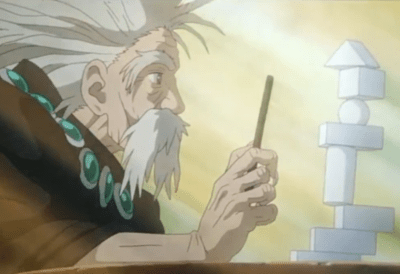

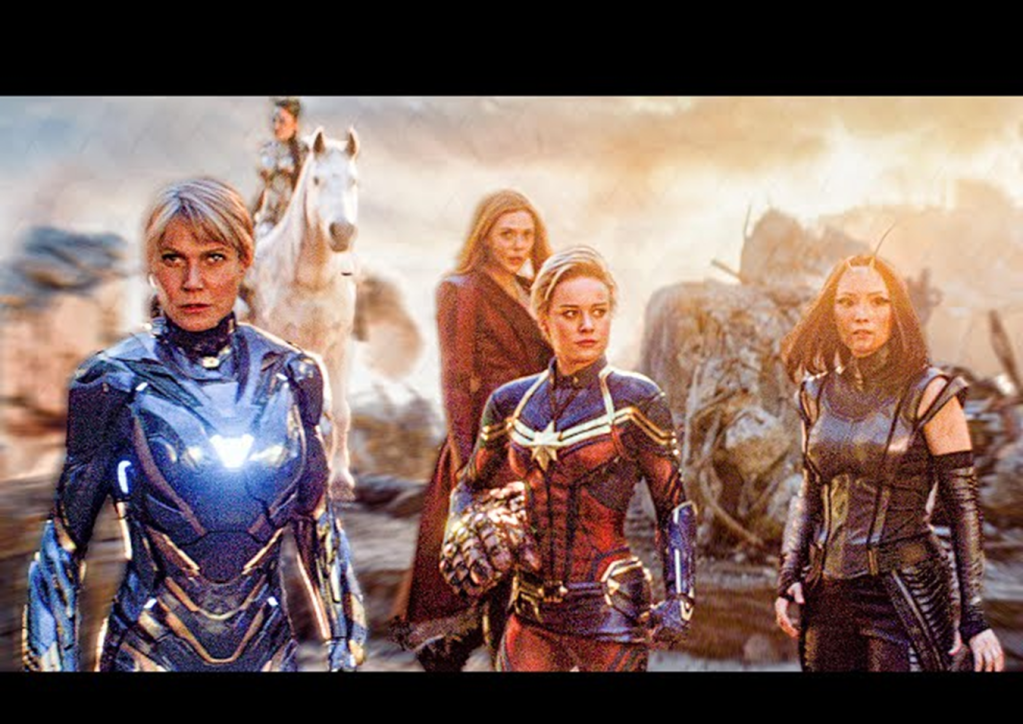
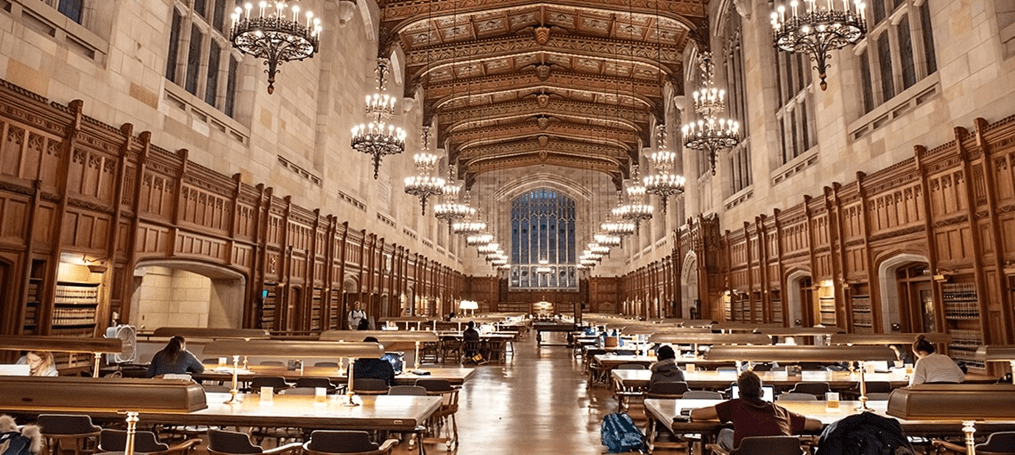

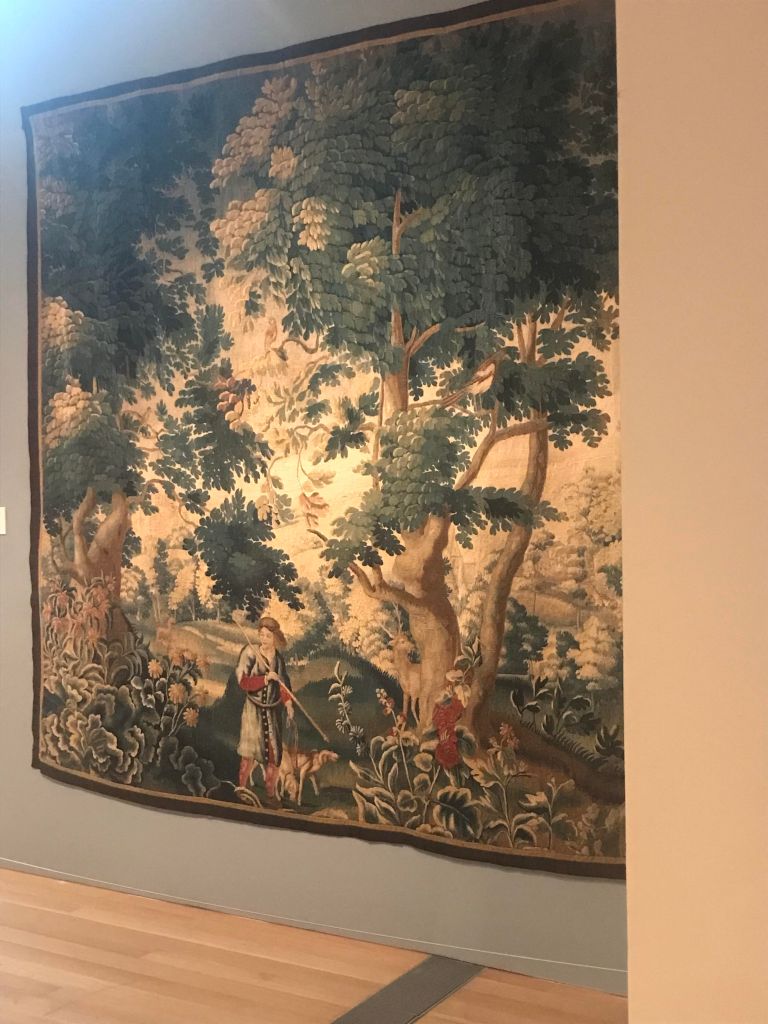
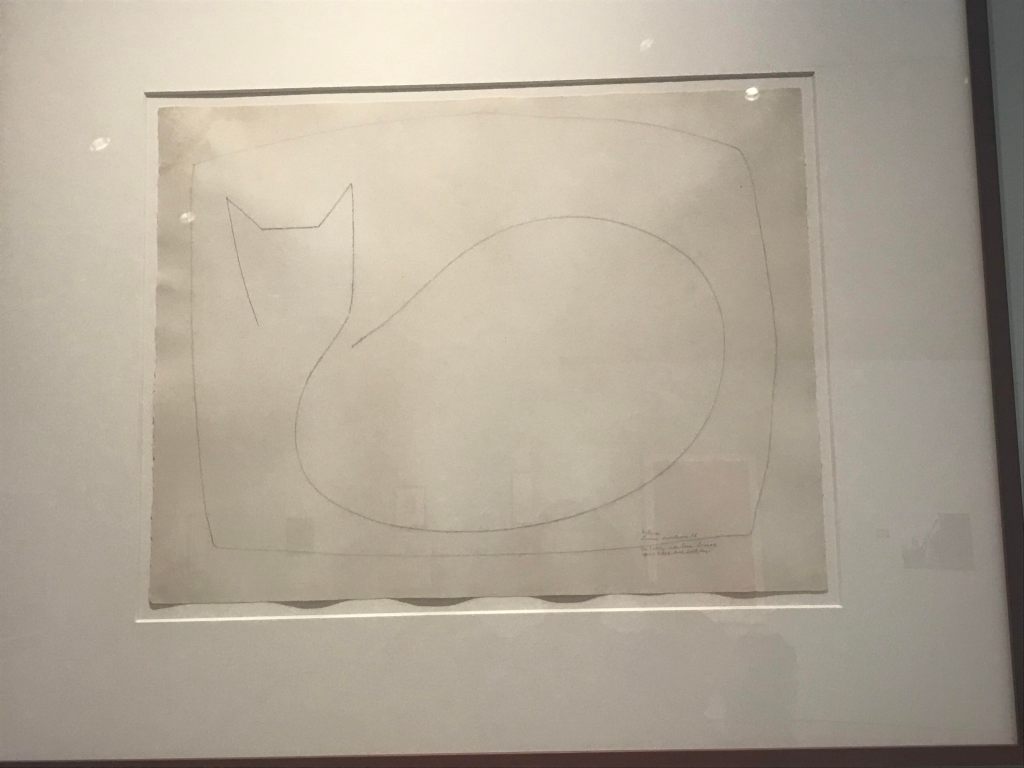
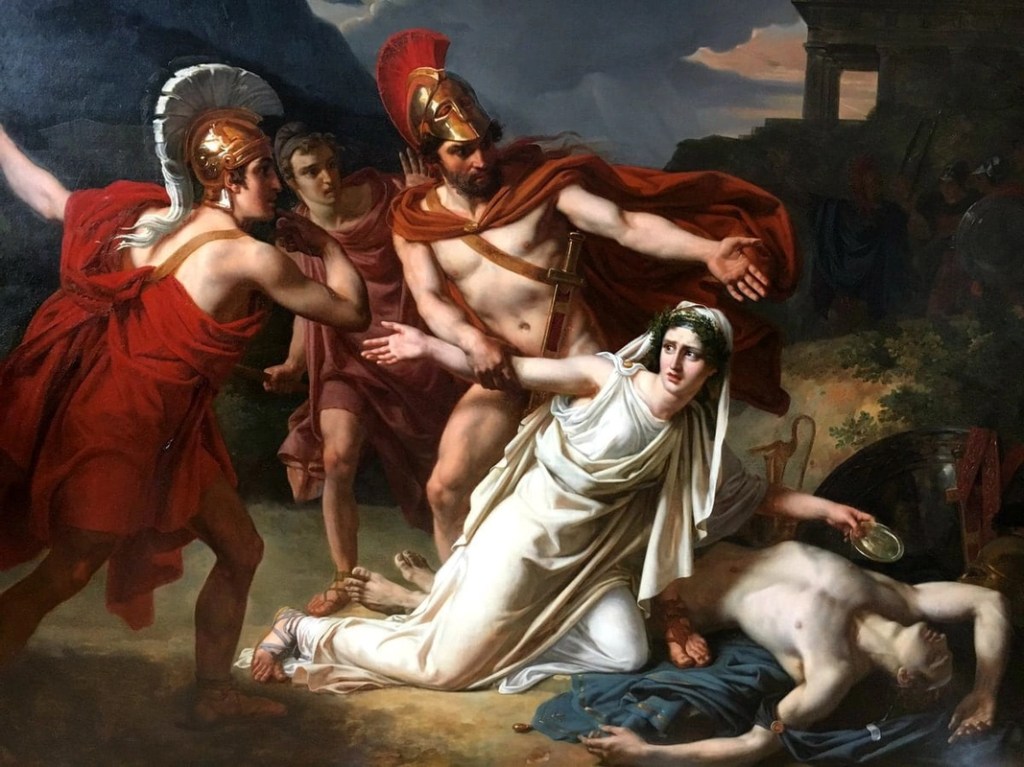
 Daniel Massett